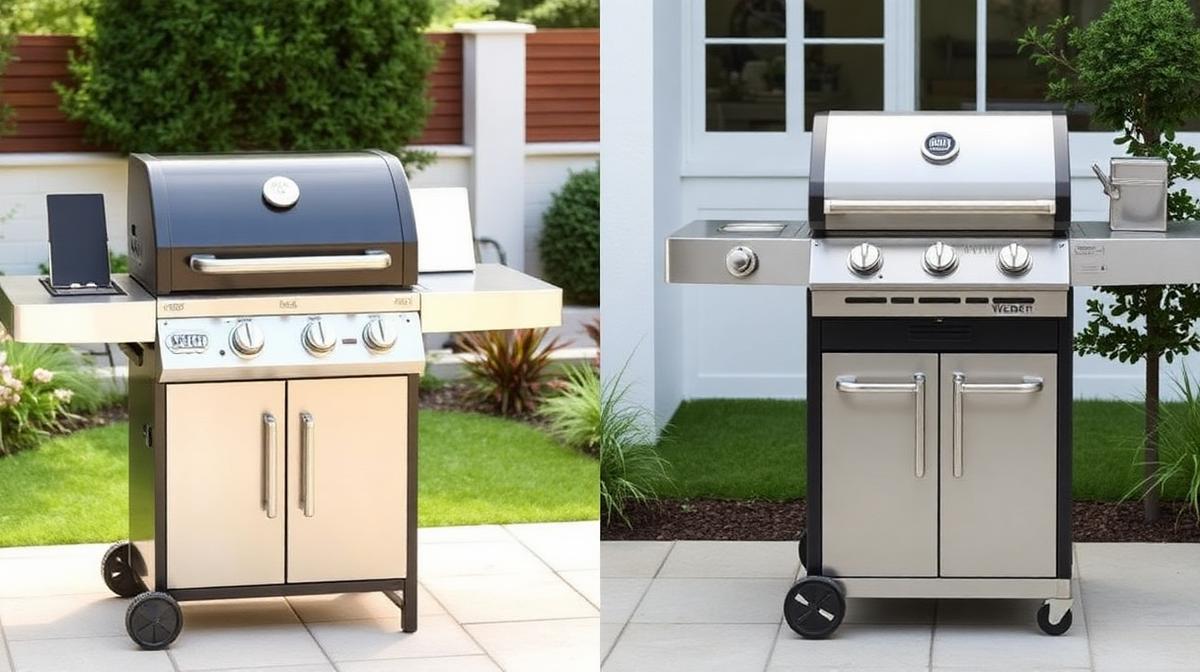
Choosing the right gas grill for home use can be difficult when two models offer similar burner counts, cooking space, and backyard-friendly features. The Weber Spirit II E-310 vs Napoleon Rogue 425 comparison is a good example because both are three-burner grills designed for regular outdoor cooking, but they differ in layout, cooking capacity, heat output, design, and overall usability.
If you are looking for a practical gas grill comparison, this guide breaks down the main differences between the Weber Spirit II E-310 and Napoleon Rogue 425 so you can decide which one better matches your cooking style.
Quick Comparison: Weber Spirit II E-310 vs Napoleon Rogue 425
| Feature | Weber Spirit II E-310 | Napoleon Rogue 425 |
|---|---|---|
| Main Burners | 3 | 3 |
| Heat Output | Around 30,000 BTU | Around 42,000 BTU |
| Primary Cooking Area | Around 418 sq. in. | Around 425 sq. in. |
| Total Cooking Area | Around 521 sq. in. | Around 576 sq. in. |
| Cooking Grates | Porcelain-enameled cast iron | Porcelainized cast iron |
| Side Shelves | Two side tables | Folding side shelves |
| Built-In Thermometer | Yes | Yes |
| Fuel Options | Gas variants available | Propane and natural gas variants available |
| Best For | Everyday family grilling | Users wanting more cooking capacity and features |
Both grills offer enough room for normal family meals, but the Rogue 425 provides more total cooking area and higher rated heat output.
Weber Spirit II E-310 Overview
The Weber Spirit II E-310 is a straightforward three-burner gas grill designed for home users who want a practical setup for regular backyard cooking.
It works well for common foods such as:
- Burgers
- Steaks
- Chicken
- Vegetables
- Sausages
- Corn
- Kebabs
Because the grill has three burners, you can create multiple heat zones. For example, one section can be used for higher-heat cooking while another area can be kept cooler for indirect cooking.
This flexibility makes the Spirit II E-310 suitable for both quick weekday meals and longer weekend grilling sessions.
Napoleon Rogue 425 Overview
The Napoleon Rogue 425 is also a three-burner gas grill but offers a slightly larger overall cooking area and higher burner output.
It is designed for users who want a little more flexibility without moving to a much larger grill.
The Rogue 425 typically includes features such as:
- Three main burners
- Cast-iron cooking grids
- Folding side shelves
- Built-in temperature gauge
- Multiple heat zones
- Side workspace
- Ignition system designed for quick startup
The larger total cooking area can make it useful for users who often prepare several different foods at once.
Cooking Space Comparison
Cooking area is one of the biggest considerations when comparing these two grills.
The Weber Spirit II E-310 provides enough primary cooking space for a typical family meal. It can comfortably handle several burgers, steaks, or chicken pieces at the same time.
The Napoleon Rogue 425 provides slightly more main cooking space and a larger total cooking area.
For everyday family use, the difference may not feel significant. However, if you regularly entertain guests or prepare multiple dishes at once, the extra space on the Rogue 425 may be useful.
When comparing a three burner grill, cooking space matters because the burners need enough room to create separate temperature zones without overcrowding the grill surface.
Heat Output: Weber vs Napoleon Gas Grill
Another major difference is rated heat output.
The Weber Spirit II E-310 provides around 30,000 BTU from its main burners, while the Napoleon Rogue 425 is rated at around 42,000 BTU.
This gives the Napoleon a higher maximum burner output.
However, BTU should not be the only factor you consider.
Actual grilling performance also depends on:
- Burner placement
- Cooking grate material
- Lid design
- Heat retention
- Grill size
- Airflow
- Cooking technique
A higher BTU rating does not automatically mean better food.
For regular backyard grilling, heat distribution and control are often more important than maximum output.
Cooking Grates
Both grills use cast-iron cooking surfaces.
The Weber Spirit II E-310 uses porcelain-enameled cast-iron grates, which are designed to hold heat well and provide a stable cooking surface.
The Napoleon Rogue 425 uses porcelainized cast-iron cooking grids with a distinctive wave-shaped design.
Cast iron is popular for gas grills because it retains heat well and can help create strong surface browning.
For most home users, both grate systems are suitable for steaks, burgers, chicken, vegetables, and similar foods.
The difference mainly comes down to the design and feel of the cooking surface.
Burner Control and Heat Zones
Both models have three burners.
This is an important advantage over smaller two-burner grills.
With three burners, you can create zones such as:
- High heat for searing
- Medium heat for general cooking
- Low heat for slower cooking
- An indirect area with one burner turned off
This gives you more control when preparing different foods at the same time.
For example, you could cook steaks over higher heat while vegetables cook more gently on another side of the grill.
For users searching for the best backyard gas grill, this flexibility is often more useful than simply choosing the grill with the highest heat rating.
Side Shelves and Workspace
Workspace is easy to overlook when buying a grill, but it matters during everyday cooking.
The Weber Spirit II E-310 includes side tables that can be used for plates, sauces, utensils, and ingredients.
The Napoleon Rogue 425 also includes side shelves, and some versions allow them to fold down.
Foldable shelves can be particularly useful if:
- Your patio is small
- Storage space is limited
- You need to move the grill frequently
- You want to reduce the grill’s footprint when not in use
For a compact outdoor space, folding side shelves can be a practical advantage.
Ease of Use
Both grills are designed for home users rather than professional outdoor kitchens.
The controls are relatively straightforward.
A typical cooking process includes:
- Open the gas supply.
- Ignite the burners.
- Preheat the grill.
- Adjust each burner to the required temperature.
- Create direct or indirect cooking zones.
- Place food on the grill.
- Monitor the built-in thermometer as needed.
The Weber has a simple layout that may appeal to users who want a straightforward grilling experience.
The Napoleon offers a few additional design features, which may appeal to users who enjoy having more flexibility.
Which Grill Is Better for Beginners?
For someone buying their first full-size gas grill, either model can work well.
The Weber Spirit II E-310 may feel slightly more approachable because of its straightforward design.
Three burners provide enough flexibility without making the cooking process overly complicated.
The Napoleon Rogue 425 is also beginner-friendly, but its additional features may be more useful for someone who expects to grill frequently.
Beginners should focus on:
- Burner control
- Cooking space
- Cleaning
- Ease of ignition
- Storage space
- Grill size
These practical factors usually matter more than small specification differences.
Which Grill Is Better for Family Cooking?
Both models work well for families.
The Weber Spirit II E-310 offers enough cooking space for common family meals such as:
- Burgers and hot dogs
- Chicken and vegetables
- Steaks and corn
- Kebabs
- Grilled sandwiches
- Mixed barbecue meals
The Napoleon Rogue 425 provides a little more total cooking area, which may be useful for larger families or people who regularly cook several foods at the same time.
If you only grill for two to four people, either grill should provide enough space.
Which Grill Is Better for Entertaining?
If you regularly cook for guests, the Napoleon Rogue 425 may offer an advantage because of its larger total cooking area.
More cooking space can help when preparing:
- Multiple burger batches
- Several cuts of meat
- Vegetables and side dishes
- Food that needs to stay warm
- Different dishes at different temperatures
The Weber is still capable of entertaining, but the additional area on the Napoleon may make larger grilling sessions easier to manage.
Design and Outdoor Space
Before choosing either grill, consider where it will be placed.
Measure:
- Available width
- Depth
- Height
- Clearance from walls
- Storage area
- Space around side shelves
The Weber Spirit II E-310 has a traditional backyard grill footprint.
The Napoleon Rogue 425 can be particularly convenient in smaller areas if you choose a version with foldable side shelves.
If your outdoor space is limited, total grill dimensions may matter more than burner power.
Cleaning and Maintenance
Both grills require regular maintenance.
Typical tasks include:
- Brushing the cooking grates
- Cleaning grease trays
- Removing food residue
- Checking burner ports
- Cleaning side surfaces
- Inspecting gas connections
- Keeping the grill covered when appropriate
Cast-iron cooking grates also benefit from proper cleaning and care.
A grill that is cleaned regularly will generally be easier to use and maintain over time.
Weber Spirit II E-310 Pros and Cons
Pros
- Three-burner design
- Good size for everyday family cooking
- Cast-iron cooking grates
- Easy-to-understand controls
- Suitable for direct and indirect grilling
- Practical side workspace
- Good option for regular backyard use
Cons
- Lower rated heat output than the Rogue 425
- Slightly less total cooking space
- May feel limited for larger gatherings
- Fewer standout design features
Napoleon Rogue 425 Pros and Cons
Pros
- Higher rated burner output
- Larger total cooking area
- Three burners for multiple heat zones
- Cast-iron cooking grids
- Folding side shelves on many versions
- Good option for entertaining
- Flexible backyard cooking setup
Cons
- May be more grill than occasional users need
- Larger overall setup
- Extra features may increase the purchase price
- Requires enough outdoor space for comfortable use
Weber Spirit II E-310 vs Napoleon Rogue 425 for Small Backyards
For smaller patios or compact outdoor spaces, grill dimensions should be one of your main considerations.
The Weber Spirit II E-310 is manageable for many standard patios.
The Napoleon Rogue 425 may offer additional flexibility if its side shelves can be folded down.
If your backyard space is limited, measure carefully before buying.
Also consider whether you need room for:
- A prep table
- Grill tools
- Gas cylinder storage
- Outdoor seating
- Food serving area
A slightly smaller grill may be more practical if it leaves enough room to move around safely.
Which One Offers Better Everyday Versatility?
Both grills are versatile enough for regular home use.
The Weber Spirit II E-310 may be a strong fit for users who want a simple, dependable three-burner setup.
The Napoleon Rogue 425 may suit users who want:
- More total cooking space
- Higher heat output
- Folding workspace
- A slightly more feature-rich design
Neither approach is automatically better.
The right choice depends on how often you grill and what type of meals you usually prepare.
Final Thoughts
The Weber Spirit II E-310 vs Napoleon Rogue 425 comparison comes down to cooking space, heat output, design, and how much flexibility you want from your grill.
The Weber Spirit II E-310 is a practical choice for everyday family grilling. It offers three burners, cast-iron cooking grates, and enough space for common backyard meals.
The Napoleon Rogue 425 provides more total cooking area, higher rated heat output, and additional design features such as foldable side shelves on many versions.
For occasional grilling and straightforward family meals, the Weber may provide everything you need.
For larger meals, regular entertaining, or users who want more cooking room, the Napoleon may be worth considering.
When choosing the best backyard gas grill for your home, focus on how you actually plan to use it. Cooking capacity, patio space, burner control, maintenance, and your typical number of guests will usually matter more than any single specification.
This article may contain affiliate links. If you use one of these links, we may earn a commission at no additional cost to you. Product details, availability and merchant information can change, so verify current information with the merchant before purchasing.
Related Guides
Related guides will appear here as more editorial content is published.